Prof. Govindsamy Bala & Prof. Ashwin K Seshadri
Climate response to greenhouse gases and solar forcing
Research in this area at CAOS examines a central question in climate change and geoengineering: how does the climate system respond not only to the magnitude of radiative forcing, but also to its spatial pattern and physical origin? Using climate-model experiments and radiative-kernel (i.e. Green’s function) methods, our recent work shows that different forcing agents (such as CO₂, methane, and solar forcing) can produce systematically different warming responses even when their global-mean radiative forcing is similar. These differences arise because the associated feedbacks, especially lapse-rate, water-vapour, albedo, and cloud feedbacks, depend strongly on whether forcing is concentrated in the tropics, high latitudes, or one hemisphere. These feedbacks also depend on the vertical structure of the forcing. This has direct implications for understanding anthropogenic climate change and for assessing proposals towards solar radiation modification. Our studies show, for example, that solar forcing generally produces a smaller global temperature response than equivalent CO₂ forcing owing to different feedback magnitudes (Figure 1); that forcing imposed at high latitudes can generate much larger warming than forcing imposed at low latitudes, mainly due to differences in lapse rate feedbacks; and that interhemispheric forcing asymmetries can shift tropical circulation and the ITCZ through cloud and heat-transport changes (Figure 2). More recently, we have also shown that methane and carbon dioxide differ in their slow climate responses because methane’s forcing pattern alters cloud, lapse-rate, and albedo feedbacks (Figure 3). Together, these studies bring out the effects of the spatial pattern of radiative forcing on atmospheric circulation and various climate feedbacks, with implications for climate sensitivity, mitigation pathways, and the regional risks and trade-offs of solar geoengineering approaches.
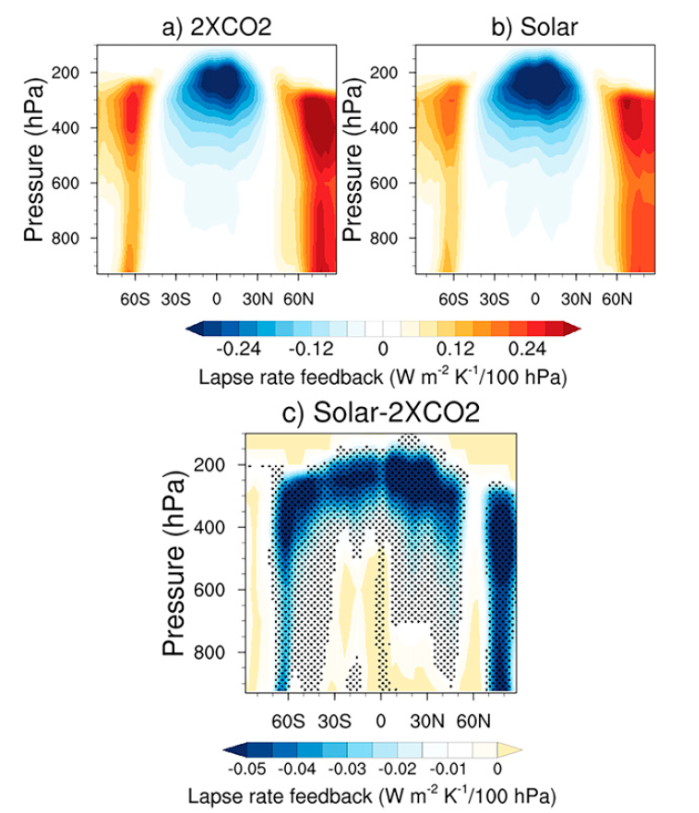
Figure 1: Comparison of zonal mean lapse rate feedbacks for CO2 and solar forcing (Source: H Kaur, G Bala, and A K Seshadri, 2023, “Why is climate sensitivity for solar forcing smaller than for an equivalent CO2 forcing?”, Journal of Climate, 36, 775-789, https://doi.org/10.1175/JCLI-D-21-0980.1).
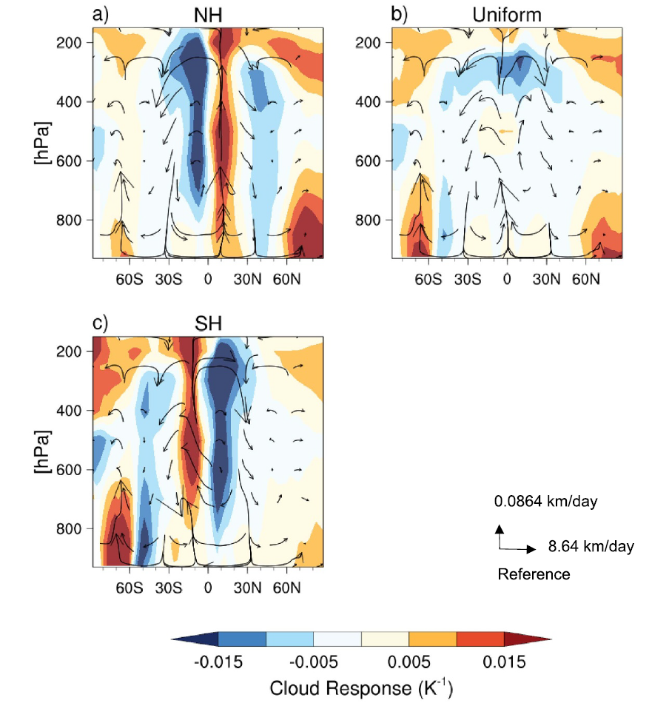
Figure 2: Changes in zonal mean cloudiness and circulation changes for solar forcing applied to the Northern Hemisphere, Uniformly around the globe, and to the Southern Hemisphere (Source: H Kaur, G Bala, and A K Seshadri, 2024, “Climate response to interhemispheric differences in radiative forcing governed by shortwave cloud feedbacks”, Environmental Research: Climate, 3, 1-21, https://doi.org/10.1088/2752-5295/ad8df6).
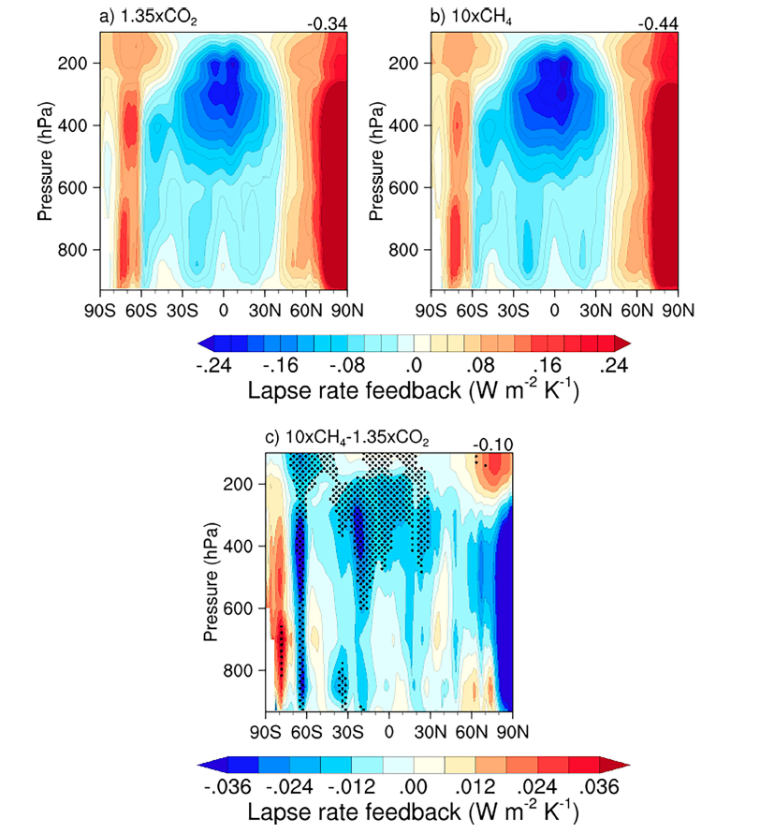
Figure 3: Comparison of zonal mean lapse rate feedbacks for CO2 and methane forcing (Source: S Kumar, A K Seshadri, and G Bala, 2025, “Contrast in slow climate response to methane and carbon dioxide forcings identified using the radiative kernel technique”, Journal of Climate, https://doi.org/10.1175/JCLI-D-24-0728.1).
Prof. Ashwin K Seshadri
Monsoon Spatial Structure and Variability
Monsoon rainfall over South Asia depends on the large-scale organization of winds, moisture transport, and energy across the Indian Ocean region. A key question is how the monsoon can show abrupt seasonal transitions, especially at onset, while remaining a robust and recurring feature of the climate system. Work in CAOS has addressed this using complementary energetics-based approaches. In the atmospheric boundary layer over the western Indian Ocean, we showed that the rapid onset of the Somali jet, a major conduit of moisture transport into the South Asian monsoon, is tied to a transition in kinetic-energy balance. As the jet forms from cross-equatorial flow near the equator, a distinctive regime emerges in which kinetic energy generation is nearly balanced by the northward transport of kinetic energy. This leads to a quadratic dependence of kinetic energy generation on the north-south pressure gradient, helping explain both the jet’s rapid intensification and its slower seasonal retreat (Masiwal et al., 2023).
Complementing this regional perspective, we developed a simple box model for the monsoon’s dry static energy budget to examine whether monsoon energetics generically imply abrupt transitions or tipping behavior (Seshadri, 2017). The analysis showed that while latent heating tends to amplify the circulation, horizontal export of a thermodynamic quantity called dry static energy acts as a strong stabilizing influence. Once vertical thermal stratification is taken into account, tipping is not a generic outcome of such simple monsoon models. Together, these studies suggest that abrupt monsoon onset can arise from identifiable nonlinear boundary-layer processes even while the seasonal-mean monsoon remains dynamically robust.
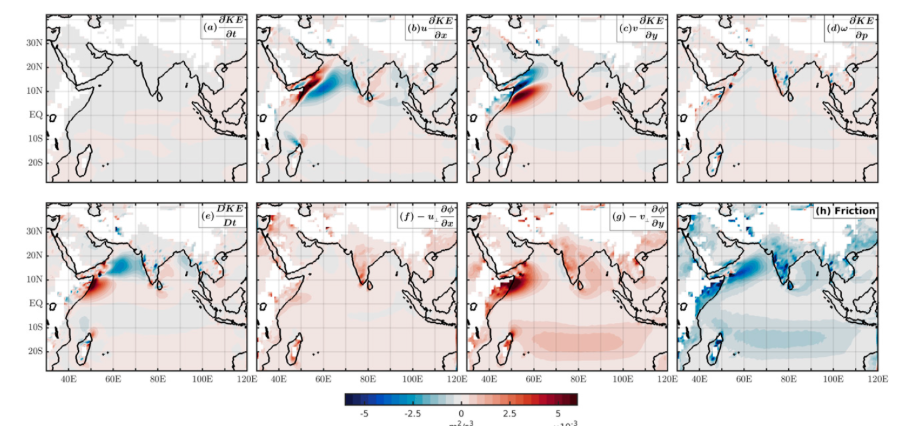
Figure 1: Seasonal-mean kinetic-energy budget of the Somali jet region, illustrating the balance between kinetic energy generation and northward advection in the near-equatorial jet-forming region, from Masiwal et al. (2023).
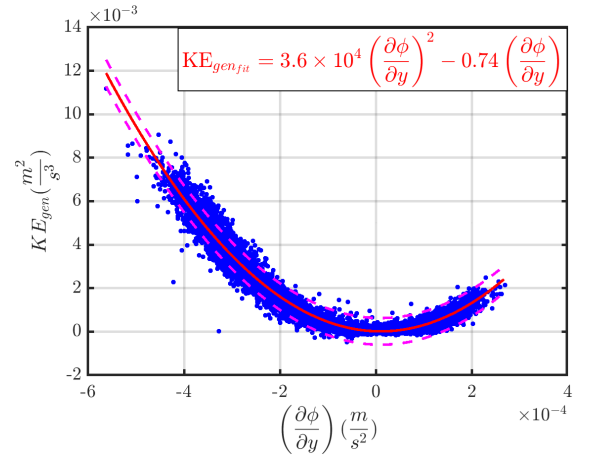
Figure 2: Quadratic relationship between the meridional geopotential gradient and kinetic energy generation in the advective boundary layer, helping explain the Somali jet’s rapid onset and slower retreat, adapted from Masiwal et al. (2023).
References
R Masiwal, V Dixit, and A K Seshadri, 2023, “Explaining dynamics and rapid onset of the Somali jet through its kinetic energy budget”, Journal of the Atmospheric Sciences, 80, 833-847, https://doi.org/10.1175/JAS-D-22-0160.1
A K Seshadri, 2017, “Energetics and monsoon bifurcations”, Climate Dynamics, 48, 561-576, https://doi.org/10.1007/s00382-016-3094-7
Prof. Bishakhadatta Gayen
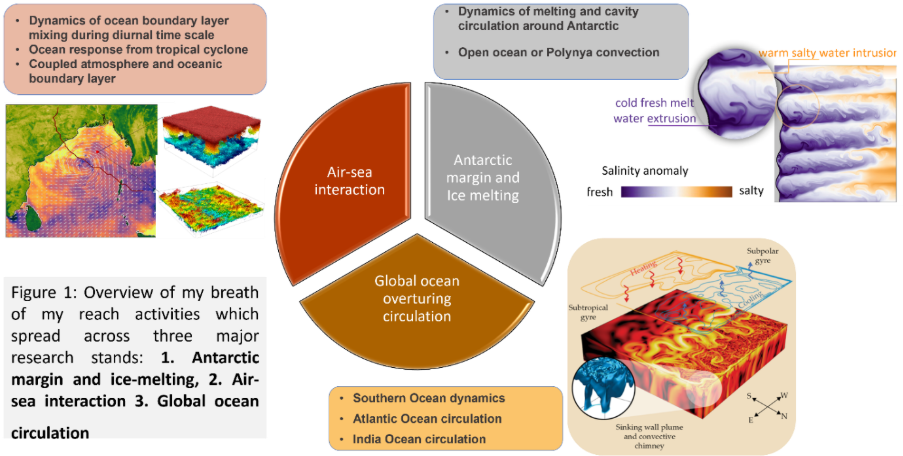
My research focuses on understanding how small-scale ocean processes regulate large-scale climate dynamics, with a particular emphasis on the tropical oceans and the Southern Ocean (Figure 1). I investigate how turbulence, convection processes control vertical mixing, heat transport, and water mass transformation—key mechanisms that influence global ocean circulation and climate variability.
A central theme of my work is to bridge the gap between microscale turbulence and basin-scale circulation using high-resolution large-eddy simulations (LES) and direct numerical simulations (DNS). In the tropical oceans, my research examines how enhanced evaporation and salinity-driven processes modify upper-ocean stratification, often counteracting warming-induced stability and leading to intensified vertical exchange. In the Southern Ocean and Antarctic regions, I focus on ice–ocean interactions, including convection beneath sea ice, basal melting of ice shelves, and the role of turbulent eddies in transporting heat toward ice boundaries.
My work has provided new physical insights into processes that are poorly represented in climate models, particularly the role of three-dimensional plume dynamics and overshooting convection in driving ocean mixing. By developing energy-conserving, turbulence-resolving frameworks, I aim to improve the representation of ocean mixing and ice–ocean coupling in Earth system models. Ultimately, this research contributes to reducing uncertainties in projections of ocean circulation, Antarctic ice melt, and global climate change.
Key References
- Rosevear, M., Gayen, B., Vreugdenhil, C. and Galton-Fenzi, B. (2025) How Does the Ocean Melt Antarctic Ice-Shelves? Annual Review Marine Science 17, doi.org/10.1146/annurev-marine-040323-074354 (Invited review article)
- Gayen, B. and Griffiths, RW (2022) Rotating horizontal convection Annual Review of Fluid Mechanics 54, 105-132 https://doi.org/10.1146/annurev-fluid-030121-115729 (Invited review article)